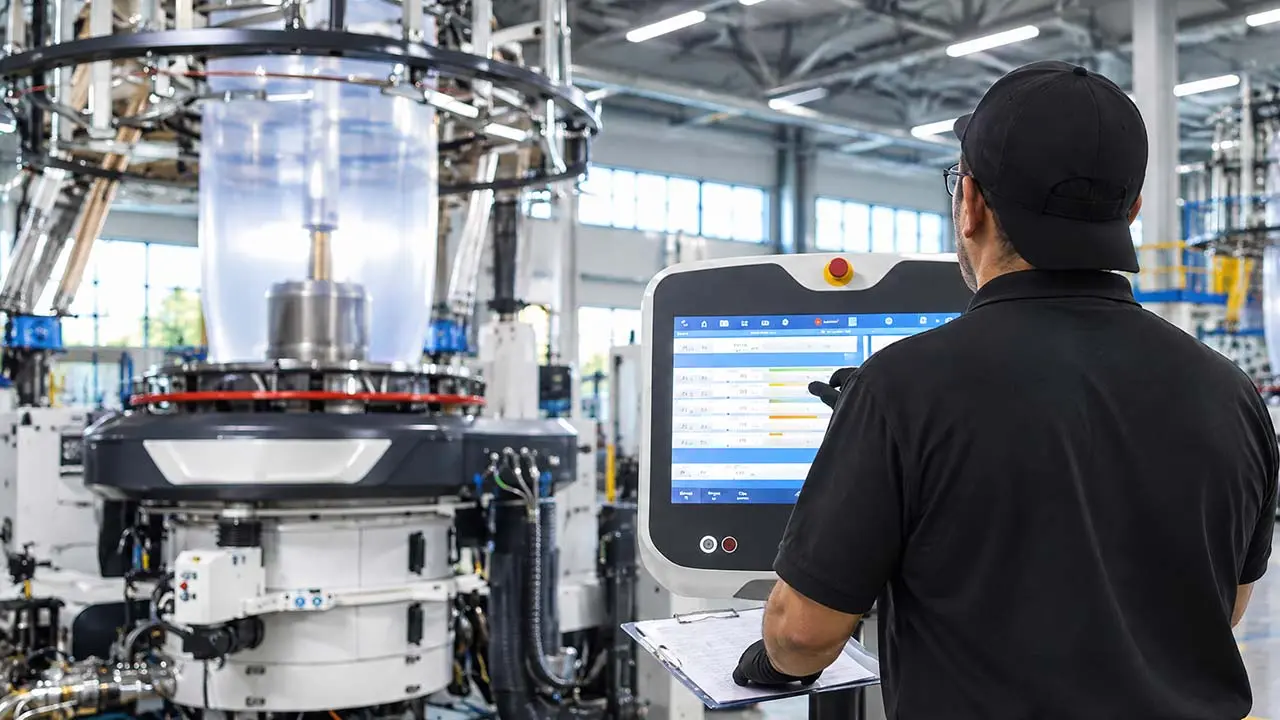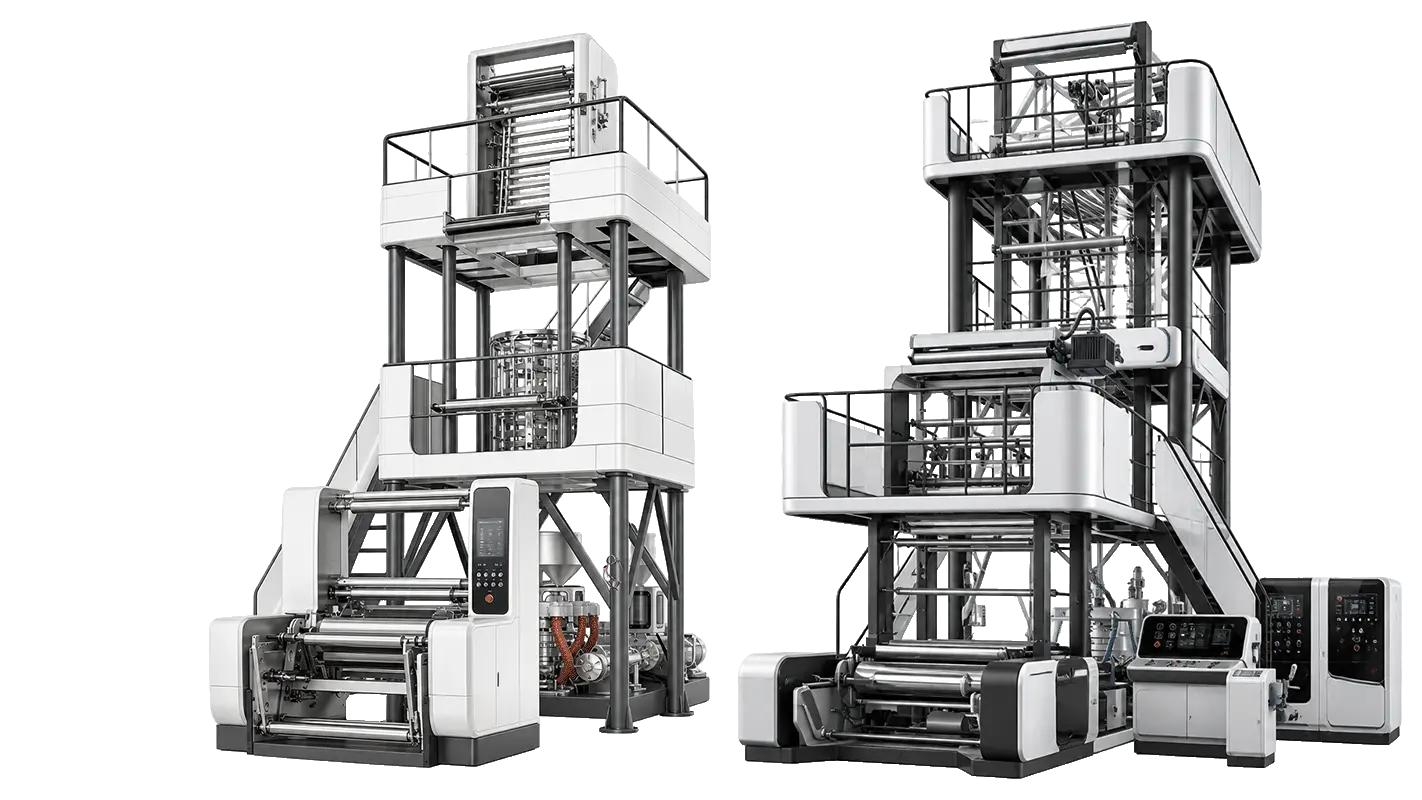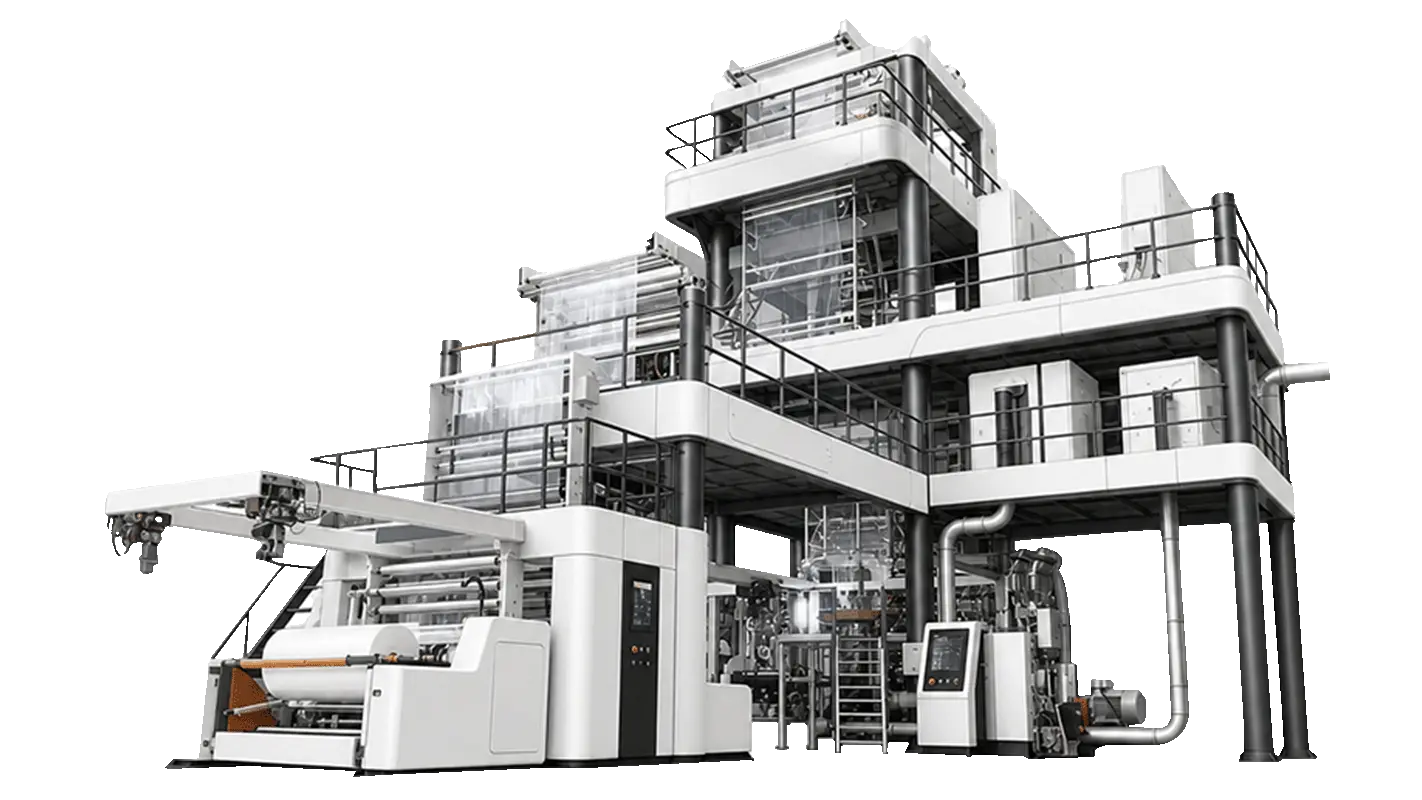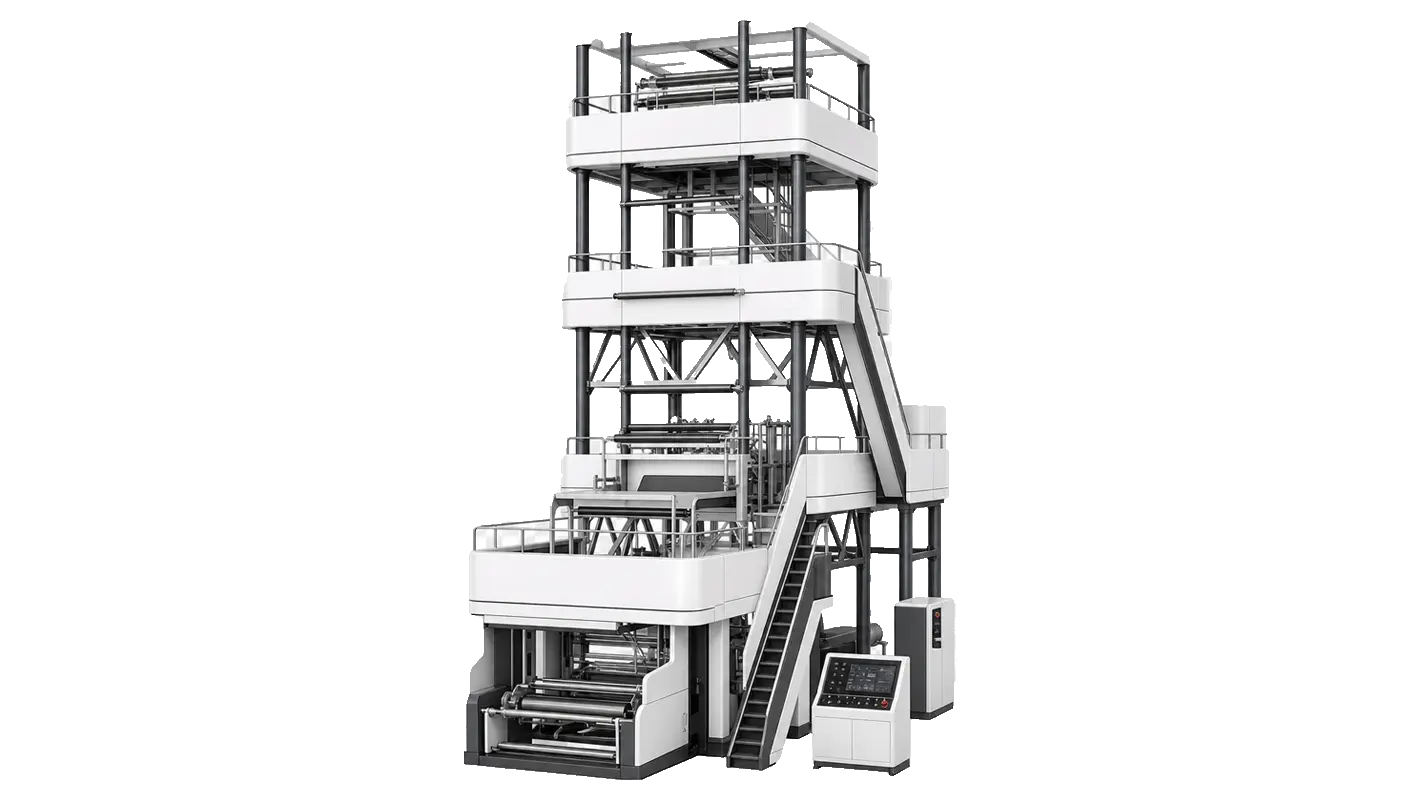
Five independent extruders. Two proven barrier structures — PE/TIE/EVOH/TIE/PE for oxygen-sensitive food packaging, PE/TIE/PA/TIE/PE for puncture-resistant industrial film. Output range 100–600 kg/h depending on configuration.
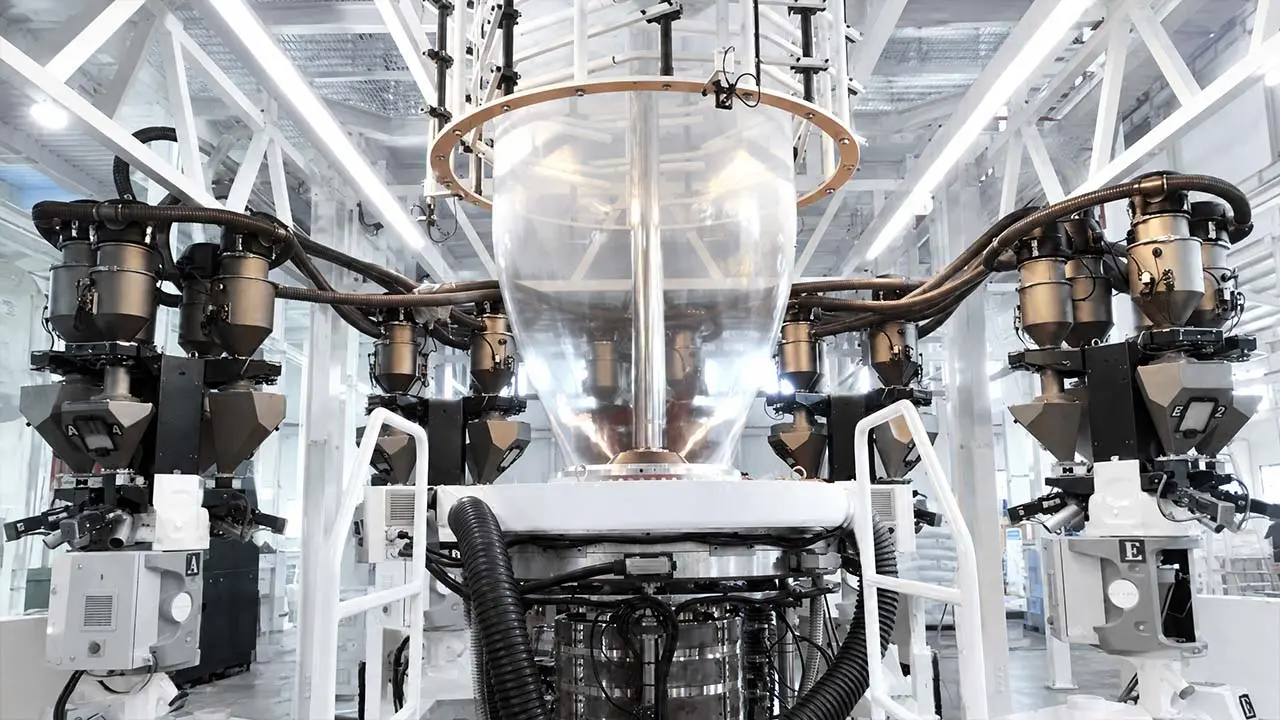
A 5-layer co-extrusion blown film machine combines five independently controlled melt streams into a single multi-layer film structure. The result is film that performs functions no single-material film can achieve — barrier against oxygen and moisture, structural strength, and heat-sealability, all in one continuous web.
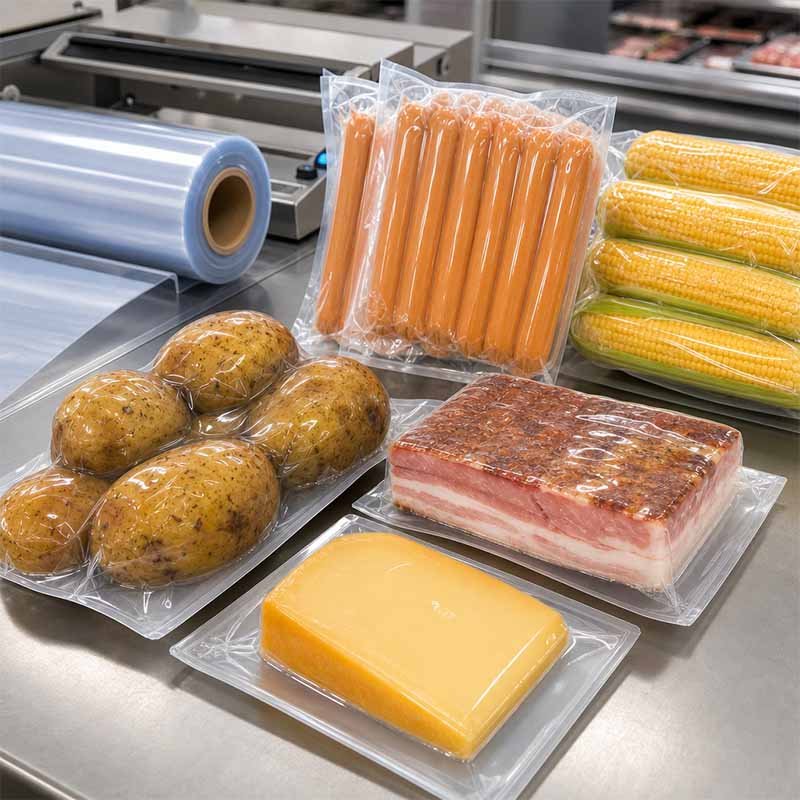
The PE/TIE/EVOH/TIE/PE structure provides oxygen barrier performance required for vacuum bags, retort pouches, frozen food packaging and modified atmosphere packaging (MAP). EVOH in the center layer blocks oxygen transmission while the outer PE layers provide heat-seal performance and moisture resistance.
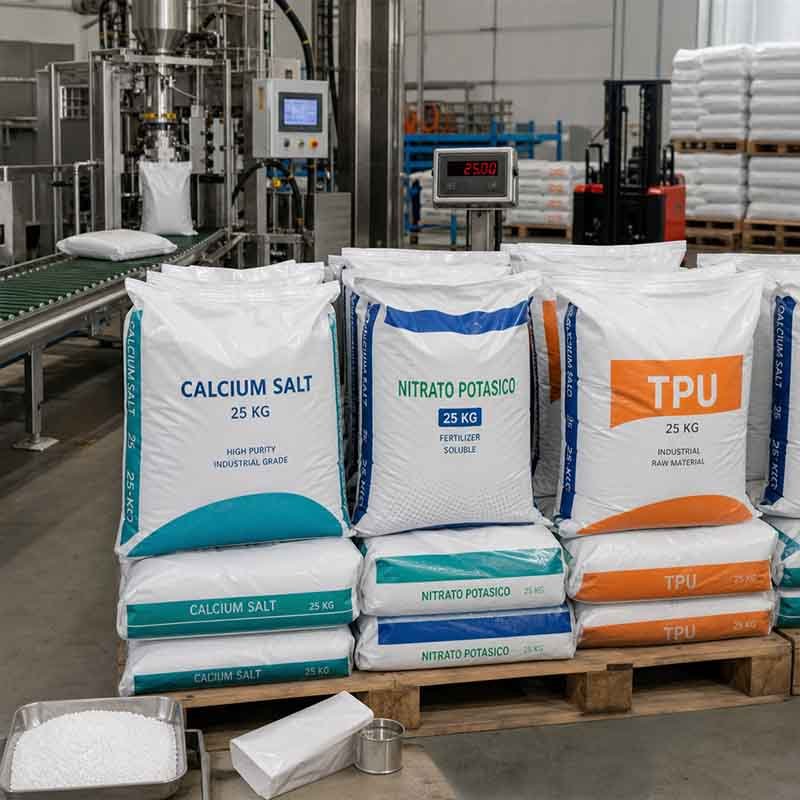
The PE/TIE/PA/TIE/PE structure uses a nylon (PA) core layer to deliver puncture resistance and mechanical strength beyond what PE alone can provide. Suitable for chemical products, agricultural inputs and industrial goods that require robust, reliable containment.
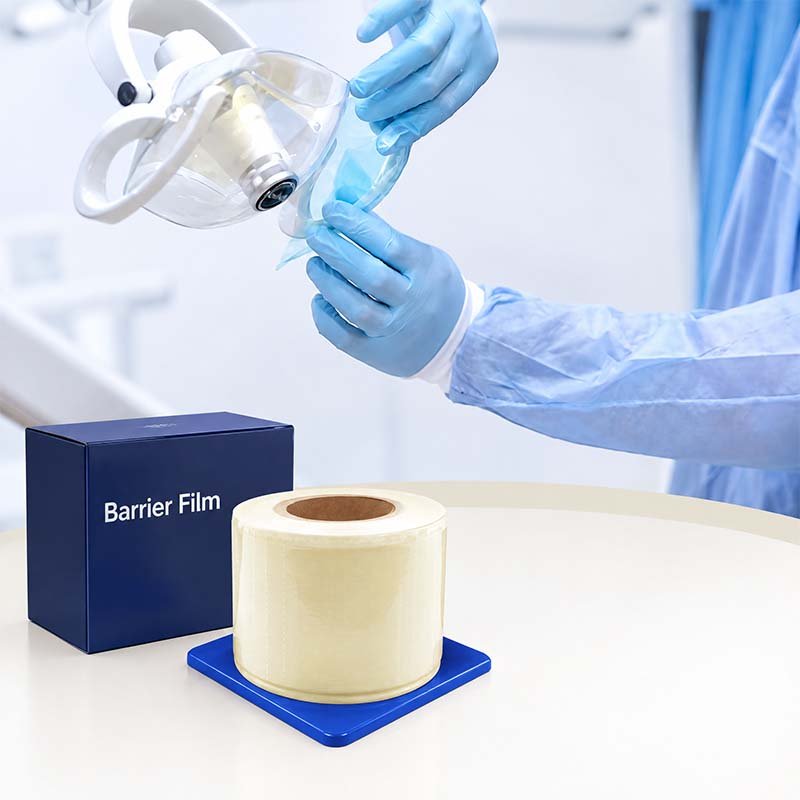
Multi-layer co-extrusion allows each layer to be assigned a distinct functional role — barrier, adhesion, structural, or surface performance. This makes 5-layer film suitable for medical device packaging, sterile barrier systems and specialty technical films where single-material structures are insufficient.
Five-layer co-extrusion is the established industry standard for flexible food packaging that requires both barrier performance and heat-seal capability. The symmetric TIE layer arrangement — one adhesive layer on each side of the barrier core — is what makes it possible to bond incompatible materials (EVOH or PA with PE) into a single, delamination-resistant film structure. LayerQuestar Machinery's 5-layer co-extrusion lines support both EVOH and PA core configurations, allowing converters to serve multiple market segments from a single machine platform.
LayerQuestar's 5-layer co-extrusion line supports two proven barrier architectures. Both use the same symmetric TIE layer logic — the choice of core material determines the barrier function the film delivers.
Thickness ratios are reference values. Each extruder's screw speed is independently adjustable to modify layer proportions during production.
| Layer | Extruder | Typical Material | Primary Function | Notes |
|---|---|---|---|---|
| Layer 1 | A | PE / LLDPE / mLLDPE | Outer surface — moisture resistance, printability | Can include slip or anti-block additives |
| Layer 2 | B | TIE (maleic anhydride grafted PE) | Adhesive — bonds outer PE to barrier core | Required when bonding incompatible materials |
| Layer 3 | C | EVOH or PA (Nylon) | Core barrier — oxygen block (EVOH) or puncture resistance (PA) | Smallest extruder — barrier layer is thin by design |
| Layer 4 | D | TIE (maleic anhydride grafted PE) | Adhesive — bonds barrier core to inner PE | Mirror of Layer 2 — symmetric structure |
| Layer 5 | E | PE / LLDPE / mLLDPE | Inner surface — heat-seal layer | Formulated for target seal temperature and strength |
The TIE layer is the element most frequently misunderstood by buyers new to multi-layer film. EVOH and PA are chemically incompatible with standard PE — they will not bond without an adhesive resin between them. TIE resins (typically maleic anhydride grafted polyethylene) are specifically engineered to create a durable chemical bond between the PE outer layers and the barrier core. Without TIE layers, the film structure would delaminate under stress. In a 5-layer structure, two TIE layers are used — one on each side of the barrier core — creating a symmetric, stable construction. LayerQuestar Machinery's 5-layer die head is designed to maintain precise layer thickness ratios across all five channels simultaneously.
LayerQuestar's 5-layer co-extrusion lines are available in LDPE/LLDPE and HDPE/LLDPE configurations. Select the model range that matches your target film width and output requirement.
| Model | Material | Output (kg/h) | Motor Power (kW) | Screw Diameter | Max Layflat Width | Cooling Fan (kW) | Floor Space (m) |
|---|---|---|---|---|---|---|---|
| LQ-5L-1100 | LDPE / LLDPE | 120–160 | 15×2 / 18.5×1 / 15×2 | Φ45/50/55/50/45 mm | 100 mm | 7.5 kW | 9×6.5×8.0 |
| LQ-5L-1300 | LDPE / LLDPE | 160–200 | 18.5×2 / 30×1 / 18.5×2 | Φ50/55/60/55/50 mm | 120 mm | 7.5 kW | 10×7×8.5 |
| LQ-5L-1600 | LDPE / LLDPE | 200–250 | 22×2 / 37×1 / 22×2 | Φ55/60/65/60/55 mm | 150 mm | 11 kW | 11×7.5×9.0 |
| LQ-5L-1800 | LDPE / LLDPE | 240–300 | 30×2 / 45×1 / 30×2 | Φ60/65/70/65/60 mm | 180 mm | 11 kW | 11×8×9.5 |
| LQ-5L-2200 | LDPE / LLDPE | 280–350 | 37×2 / 55×1 / 37×2 | Φ65/70/75/70/65 mm | 220 mm | 15 kW | 12×8.5×10.0 |
| LQ-5L-2500 | LDPE / LLDPE | 350–450 | 45×2 / 75×1 / 45×2 | Φ70/80/85/80/70 mm | 250 mm | 15 kW | 13×9×10.5 |
| LQ-5L-3200 | LDPE / LLDPE | 450–600 | 55×2 / 90×1 / 55×2 | Φ80/85/90/85/80 mm | 650 mm | 18.5 kW | 14×10×11.5 |
| Model | Material | Output (kg/h) | Motor Power (kW) | Screw Diameter | Max Layflat Width | Cooling Fan (kW) | Floor Space (m) |
|---|---|---|---|---|---|---|---|
| LQ-5L-900 | HDPE / LLDPE | 100–120 | 15×2 / 18.5×1 / 11×2 | Φ45/45/50/45/45 mm | 80 mm | 5.5 kW | 8×6×7.5 |
| LQ-5L-1100 | HDPE / LLDPE | 120–160 | 15×2 / 18.5×1 / 15×2 | Φ45/50/55/50/45 mm | 100 mm | 7.5 kW | 9×6.5×8.0 |
| LQ-5L-1300 | HDPE / LLDPE | 160–200 | 18.5×2 / 30×1 / 18.5×2 | Φ50/55/60/55/50 mm | 120 mm | 7.5 kW | 10×7×8.5 |
| LQ-5L-1600 | HDPE / LLDPE | 200–250 | 22×2 / 37×1 / 22×2 | Φ55/60/65/60/55 mm | 150 mm | 11 kW | 11×7.5×9.0 |
| LQ-5L-1800 | HDPE / LLDPE | 240–300 | 30×2 / 45×1 / 30×2 | Φ60/65/70/65/60 mm | 180 mm | 11 kW | 11×8×9.5 |
| LQ-5L-2200 | HDPE / LLDPE | 280–350 | 37×2 / 55×1 / 37×2 | Φ65/70/75/70/65 mm | 220 mm | 15 kW | 12×8.5×10.0 |
| LQ-5L-2500 | HDPE / LLDPE | 280–350 | 37×2 / 55×1 / 37×2 | Φ65/70/75/70/65 mm | 250 mm | 15 kW | 13×9×10.5 |
Output figures are reference values under standard operating conditions and vary by film thickness, material formula and layflat width. Contact LayerQuestar for a configuration-specific proposal tailored to your product requirements.
380V / 50Hz standard. 440V / 60Hz available on request. Confirm local supply before ordering.
Minimum 8.0m for mid-range models. Larger configurations (LQ-5L-2500 and above) require 10.5m or higher. Refer to model-specific floor space data above.
Five separate material hoppers require dedicated storage areas for PE, TIE and EVOH or PA resins. EVOH and PA must be stored in dry conditions and pre-dried before processing.
Required for bubble inflation and IBC (internal bubble cooling) system where fitted. Confirm air supply capacity with LayerQuestar during configuration.
A 5-layer co-extrusion line is a significant step up in complexity and capital investment from a 3-layer machine. This section helps you determine whether the application genuinely requires 5-layer capability.
| Your Requirement | Recommended Configuration |
|---|---|
| Shopping bags, T-shirt bags, garbage bags | Mono-Layer Machine → |
| Courier bags, lamination film, PCR isolation | 3-Layer ABA/ABC Machine → |
| Food packaging with oxygen barrier (EVOH), heavy-duty industrial film (PA) | 5-Layer Co-Extrusion Line — this page |
| Ultra-high barrier, asymmetric structures, extended shelf-life packaging | 7-Layer EVOH Barrier Line → |
| PLA/PBAT compostable film | Biodegradable Film Machine → |
A 5-layer line requires more operator attention than a 3-layer machine — five independent material streams, each with its own temperature profile, feed rate and screw speed. Here is what to plan for.
A 5-layer co-extrusion line typically requires 2–3 operators per shift under normal production conditions — one lead operator managing the five extruder control panels and die head, one winding/roll-change operator, and optionally one material handling assistant for the five separate resin hoppers. Prior experience with multi-layer extrusion is recommended for the lead operator role.
EVOH and PA resins are moisture-sensitive. Both materials must be pre-dried before processing — EVOH typically at 80°C for 4–6 hours, PA at 80–85°C for 8–12 hours, depending on the specific grade and ambient humidity conditions. Failure to pre-dry will result in bubble instability, surface defects and reduced barrier performance. Dedicated drying hoppers for the C extruder are strongly recommended.
Each extruder's screw speed can be adjusted independently to change the thickness ratio of individual layers without stopping production. The EVOH or PA core layer is typically set to 5–15% of total film thickness — enough to deliver barrier performance while minimising the cost of the most expensive resin in the structure. Operators can fine-tune ratios in response to material cost changes or customer specification adjustments.
Switching between EVOH and PA core structures requires a full purge of the C extruder and die head C channel. EVOH is particularly sensitive to thermal degradation if left in the barrel at processing temperature without material flow. Purging protocols and maximum idle time limits should be established before production begins. LayerQuestar provides recommended purging procedures as part of the machine commissioning documentation.
5-layer barrier film rolls are compatible with downstream slitting, printing and bag making equipment. For food packaging applications, the film typically proceeds to a flexographic printer for surface printing, then to a bag making machine for pouch or bag conversion. Confirm downstream equipment specifications — particularly seal bar temperature settings — are calibrated for the specific film structure being produced.
Every component specification in a LayerQuestar 5-layer co-extrusion line is selected for long-term reliability under continuous industrial operation. These are the hardware standards applied to every machine we build.
Every LayerQuestar 5-layer co-extrusion line runs a continuous 72-hour production test at our Zhejiang factory before shipment. During the FAT, all five extruders run simultaneously under load. Output consistency, temperature stability across all five zones, film thickness tolerance (±8% target), layer ratio accuracy, winding quality and all mechanical and electrical systems are verified and documented.
Buyers and their representatives are welcome to witness the FAT in person before final payment and dispatch. Test reports are provided with every machine.
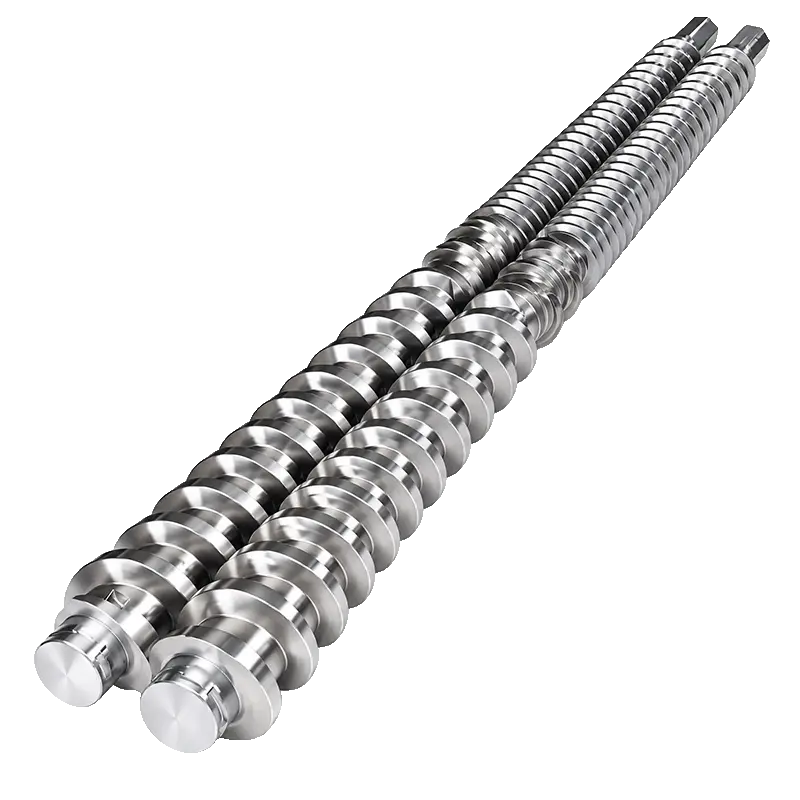
Base material: 38CrMoAlA nitrided steel. 1.5–3mm tungsten carbide alloy overlay on screw flight. HRC 59–65 surface hardness. Applied across all five extruders. Designed for long-term abrasion resistance when running filled compounds and recycled content blends.
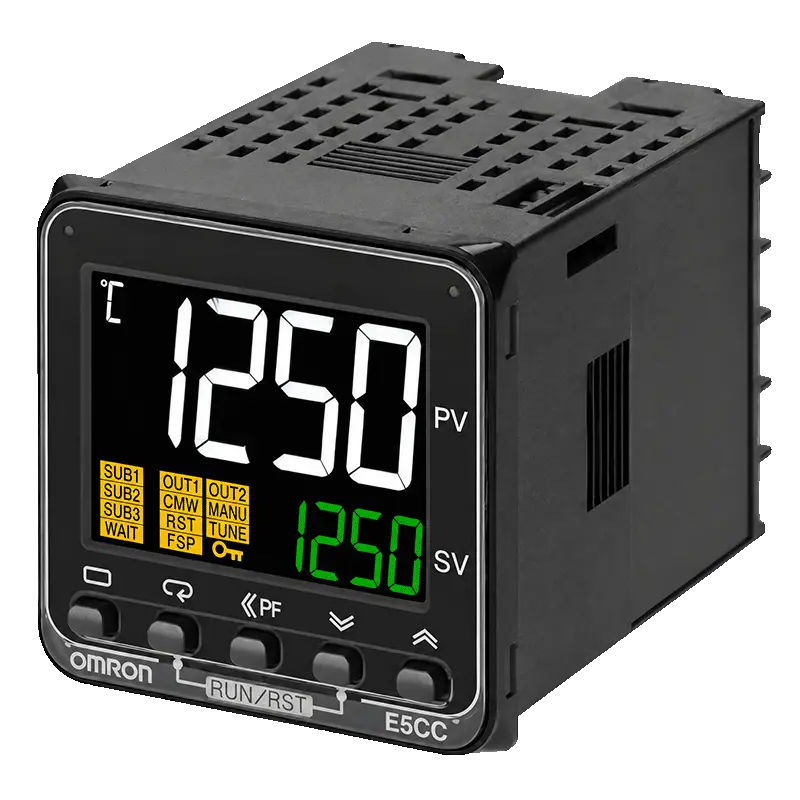
OMRON PID controllers fitted to all five extruder barrel zones and die head channels. Temperature deviation ±1°C under stable operating conditions. Critical for EVOH processing — EVOH has a narrow processing window and requires precise, consistent temperature control to maintain barrier integrity and avoid thermal degradation.
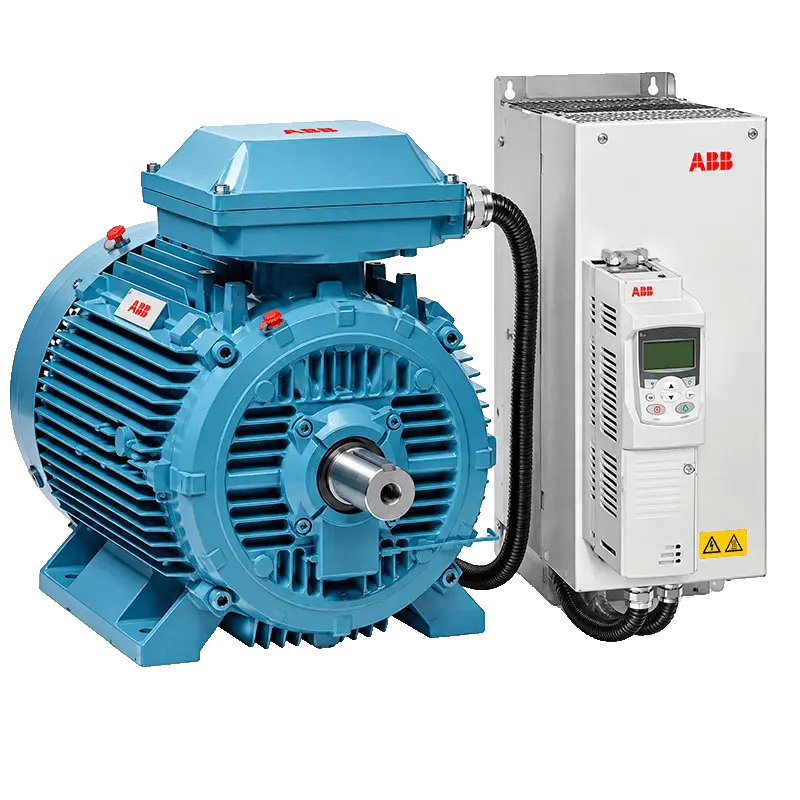
ABB motors are the preferred specification for all five extruder drives. Innomotics and other internationally recognised brands are available on request. Five independent variable-frequency drives allow each extruder's screw speed — and therefore each layer's output rate — to be adjusted independently during production.
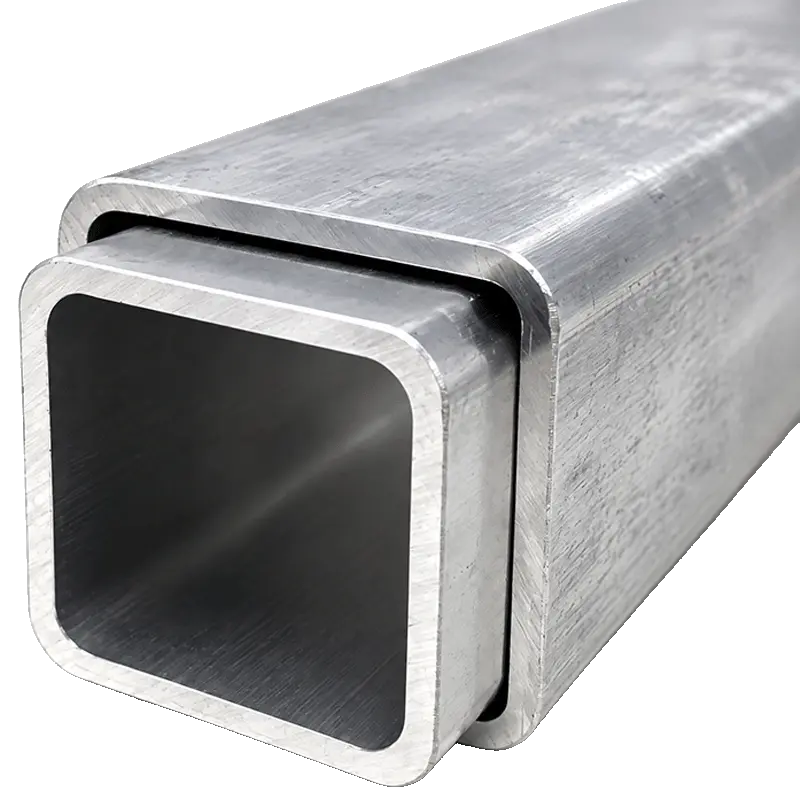
The machine frame is constructed from 140mm heavy-wall square steel tube throughout. A 5-layer line carries the combined weight and vibration load of five extruder assemblies — frame rigidity directly affects long-term alignment stability of the die head and winding system. This specification is applied consistently across all LayerQuestar co-extrusion line sizes.
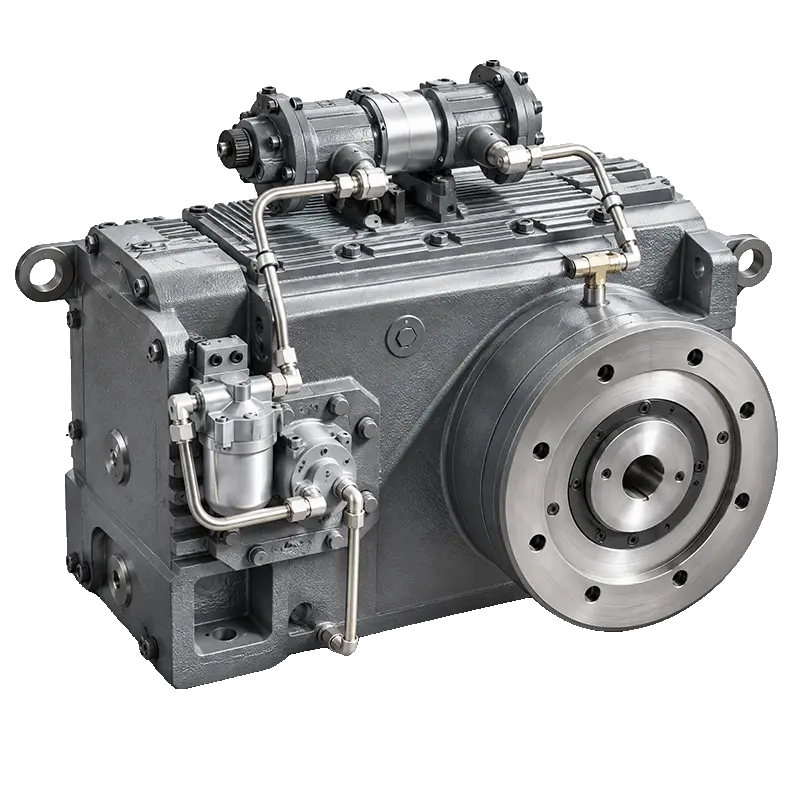
Each of the five extruders is fitted with an external oil-cooled circulation gearbox, designed for 8–10 years of continuous service life under normal operating conditions. External oil cooling maintains consistent gearbox temperature during extended production runs, reducing thermal wear on gear surfaces and extending oil change intervals.
A 5-layer co-extrusion line is a long-term production asset. LayerQuestar Machinery provides structured after-sales support to protect that investment from day one.
12-month warranty on mechanical and electrical components from the date of commissioning. Warranty covers manufacturing defects and component failures under normal operating conditions. Consumable wear parts are excluded from warranty coverage.
Screw and barrel sets, die head components, heater bands, temperature sensors and other scheduled wear parts are held in stock at our Zhejiang facility. Parts are available for order independently of any service contract. Critical wear parts for 5-layer lines are stocked with priority given the higher component count versus single-extruder machines.
Video call support is available for commissioning assistance, process troubleshooting and operator training. Our technical team can review live machine data, control panel readings and film samples remotely to diagnose issues without requiring an on-site visit. On-site commissioning and installation support is available — contact LayerQuestar for terms applicable to your location.
Every machine ships with a complete English-language documentation package: operation manual, electrical schematics, spare parts list with part numbers, recommended maintenance schedule, and FAT test report. The control cabinet is fully English-labeled. Documentation in additional languages is available on request.
Questions buyers and engineers ask most often about 5-layer co-extrusion blown film machines and barrier film production.
A 3-layer machine produces film where all three layers are made from compatible materials — typically PE-family resins that bond to each other without adhesives. A 5-layer machine introduces a barrier core material (EVOH or PA) that is chemically incompatible with PE. Two additional TIE (adhesive) layers are required — one on each side of the barrier core — to bond the structure together. The result is a film that can block oxygen transmission or resist puncture at a level that PE alone cannot achieve. The trade-off is higher material cost, greater process complexity, and the need for five independent extruders and a 5-channel die head.
EVOH (ethylene vinyl alcohol) is selected primarily for its oxygen barrier performance. It is the standard choice for food packaging applications where extending shelf life by blocking oxygen transmission is the primary requirement — vacuum bags, retort pouches, MAP film and dairy packaging are typical examples.
PA (polyamide / nylon) is selected primarily for mechanical performance — puncture resistance, abrasion resistance and tensile strength. It is the standard choice for heavy-duty industrial packaging where the film must withstand rough handling, sharp edges or heavy loads. Chemical bags, fertilizer packaging and industrial liner bags are typical examples.
The two materials are not interchangeable — they serve different performance requirements. LayerQuestar's 5-layer line supports both configurations. If your application requires both oxygen barrier and puncture resistance simultaneously, contact us to discuss 7-layer structures that can combine both functions.
A TIE layer is a thin adhesive resin layer — typically maleic anhydride grafted polyethylene — that creates a chemical bond between two otherwise incompatible materials. PE and EVOH will not bond to each other directly; without a TIE layer between them, the film structure would delaminate under mechanical stress or during heat sealing.
In a 5-layer PE/TIE/EVOH/TIE/PE structure, two TIE layers are used — one between the outer PE and the EVOH core, and one between the EVOH core and the inner PE. This symmetric arrangement ensures the barrier core is fully bonded on both sides, creating a stable, delamination-resistant film. The TIE layer is typically very thin (5–10% of total film thickness) but is essential to the structural integrity of the film.
Technically yes — a 5-layer machine can run PE-only structures by feeding compatible PE-family resins into all five extruders. However, this is not an economically rational use of the machine. A 5-layer co-extrusion line carries significantly higher capital cost, operating complexity and maintenance requirements than a 3-layer machine. Running it on standard PE film means paying for capability you are not using.
If your current and foreseeable product range does not require EVOH or PA barrier layers, a 3-layer ABA or ABC machine is the more appropriate investment. Contact LayerQuestar and we will recommend the configuration that matches your actual production requirements.
Yes. EVOH has a narrower processing window than PE and is sensitive to both under-heating and over-heating. Processing temperatures typically range from 190°C to 230°C depending on the specific EVOH grade and ethylene content — lower ethylene content grades generally require higher processing temperatures. EVOH is also sensitive to moisture: it must be pre-dried before processing (typically at 80°C for 4–6 hours) and should be protected from ambient humidity during storage and feeding.
Critically, EVOH degrades if left in the barrel at processing temperature without material flow. If production is interrupted, the EVOH extruder must be purged promptly. LayerQuestar's OMRON PID temperature control system — with ±1°C deviation under stable conditions — is specified in part to meet the precise temperature management requirements of EVOH processing.
The centre extruder (C) feeds the EVOH or PA barrier core layer, which is intentionally kept thin — typically 5–15% of total film thickness. EVOH and PA are significantly more expensive than PE, so minimising their proportion while maintaining barrier performance is a key part of the film cost structure. A smaller screw diameter on Extruder C is correctly matched to this lower output requirement.
The outer PE layers (Extruders A and E) carry the majority of the film's total thickness and require higher output capacity — hence the larger screw diameters. This asymmetric extruder sizing is standard practice in 5-layer barrier film line design and is reflected in LayerQuestar's model specifications.
Yes. Each extruder's screw speed is independently controlled via its variable-frequency drive. Adjusting the screw speed of any individual extruder changes that layer's output rate and therefore its proportion of the total film thickness. This can be done while the line is running without stopping production.
In practice, operators adjust layer ratios in response to changes in raw material costs, customer specification requirements, or film performance targets. The EVOH or PA core layer ratio is typically the most actively managed — increasing it improves barrier performance but raises material cost, while reducing it lowers cost but may reduce barrier performance below specification.
Under normal production conditions, a 5-layer co-extrusion line typically requires 2–3 operators per shift. A lead operator manages the five extruder control panels, die head and process parameters. A second operator handles winding, roll changes and film quality monitoring. A third operator — optional depending on line size and production pace — manages material feeding across the five hoppers and assists with roll handling.
Prior experience with multi-layer extrusion is recommended for the lead operator role, particularly for EVOH processing where temperature management and purging protocols are critical. LayerQuestar provides operator training as part of the commissioning process and remote training support is available after installation.
Tell us your target film structure, output requirement and product application. LayerQuestar Machinery will recommend the right model and configuration for your production goals.
Response within 1 business day · info@layerquestar.com